Canadiens Daily
Canadiens: Value Of Moving Down & Cost Of Trading Up At NHL Draft


Every year there’s word that a team may consider moving up or moving down at the NHL Entry Draft, as was the case last season when some suggested the Montreal Canadiens were possibly going to trade out of the top 5.
We’re hearing the same rumblings this season, seeing as the Canadiens want to draft a forward and there’s a possibility they could still nab a high-end talent while accumulating important assets in a trade with a team intent on moving up.
Any general manager around the league will admit they’re willing to look into moving up or down, but that’s simply performing due diligence.
Pulling the trigger on such a deal is very difficult for many reasons. Teams will only move down if they’re paid a king’s ransom, while teams will only move up if they somehow manage to find value in a trade that offers little to no value.
As far as I can tell, the only general manager who intentionally traded away a top-three pick in the last 30 years was Mike Milbury, who sent Zdeno Chara, Bill Muckalt, and a first-round pick (2001 No.2 overall – Jason Spezza) to the Ottawa Senators in exchange for Alexei Yashin.
Suffice it to say, much like most of Milbury’s decisions as an executive, the trade represents one of the worst decisions in NHL history.
Top-5 Movement Is Rare
While there haven’t been any trades involving the top three picks in the NHL in the last 20 years, there has been one trade involving the fifth overall pick.
The Islanders moved the fifth overall pick to the Toronto Maple Leafs in 2008. In return, they received the seventh overall pick in 2008, the 68th overall pick, and the 37th overall pick in 2009. In other words, they received a mediocre third-round pick and a half-decent second-round pick to move down two spots.
Not bad, but far from great.
New York then turned around and moved the seventh overall pick to the Nashville Predators for the ninth overall pick and the 40th overall pick.
Once it was all said and done, they were essentially paid two second-round picks and a third-round pick to move down four spots.
That may fly when evaluating NHL draft value charts, but you’d be hard-pressed to find a Canadiens fan who would endorse adding relatively mediocre assets to the fold in exchange for dropping down several spots.
Of course, it all depends on the situation.
If someone like Berkly Catton projects to be available, moving down may be worth it, but there’s also a significant discrepancy in talent between someone like Catton and someone like Cayden Lindstrom, who is not expected to be available beyond fifth overall.
MUST READ: Cayden Lindstrom A Prime Draft Target For The Canadiens
For some teams, moving down makes sense.
But the Montreal Canadiens need elite talent, not trades that bring them slight upgrades on future assets that are unlikely to make an impact on the team’s long-term rebuild plans.
And if a team is willing to buck the trend and offer the moon to move up to Montreal’s spot, there’s probably a very good reason why they’re willing to make such a move.
That reason may be enough to convince Kent Hughes and Co. that staying put is probably the best decision.
The Cost Of Moving Up And Down At The NHL Draft
(Editor’s Note: Some parts of the article below were originally published last year. We are adding them to this article so fans can understand the suggested value of various picks in the NHL’s Entry Draft.)
There are a few existing Draft models that can give us a better idea of the cost involved in moving up at the NHL Draft.
The first, and most referenced, is the excellent work done by Michael Schuckers, one of the most respected data analysts in sports.
The value model is based on the first 215 players drafted during 10 consecutive drafts, running from 1988 to 1997.
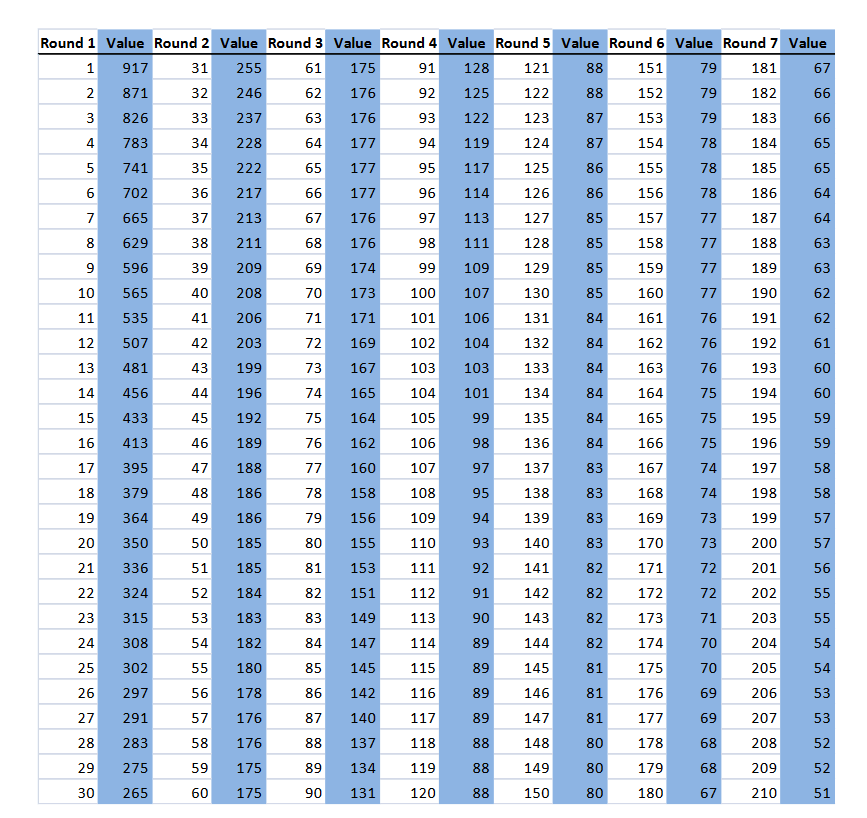
Dom Luszczyszyn took it one step further, implementing newer metrics into the formula, including GSVA, which stands for Game Score Value Added. GSVA is used to project a player’s overall impact during a season.
Luszczyszyn concluded that Schucker’s model was inflating the value of late-round picks and that the mid-round picks could provide value, but much less than previously expected. He also opined that Schucker may have underestimated the gap between the top players in the first round.
His pick value chart differs significantly from Schuckers.
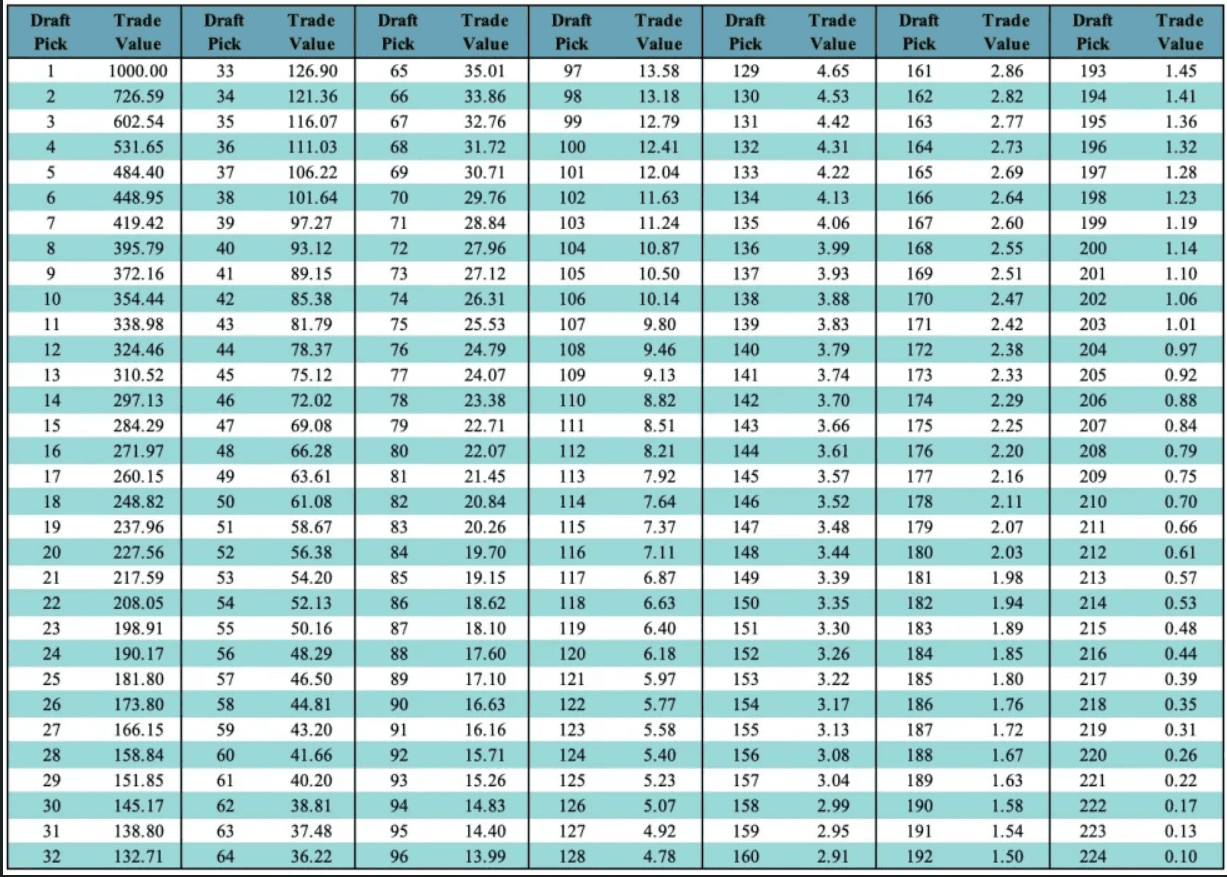
Trade Value
To better understand the actual cost associated with moving up, we can reference ‘s pick value chart, which puts an onus on the price paid by NHL teams to move up in previous drafts rather than a player’s potential impact.
Montreal Canadiens Brass Tacks
Even though the charts suggested getting a second-round pick is enough compensation for moving down a few spots, I’d argue there’s very little point in trading down at this stage of the Canadiens’ rebuild.
The Habs need to draft the best player available. Full stop.
2024 may be the last time they have an opportunity to draft a top 5 talent in a very long time.
Accumulating draft capital is important, but it should never take precedence over drafting a player who could eventually become an impact presence in the lineup.
If teams are still interested in moving up in later rounds, there may be an opportunity to swing a few smart trades.
But in the first round, the name of the game for the Montreal Canadiens is quality, not quantity.
